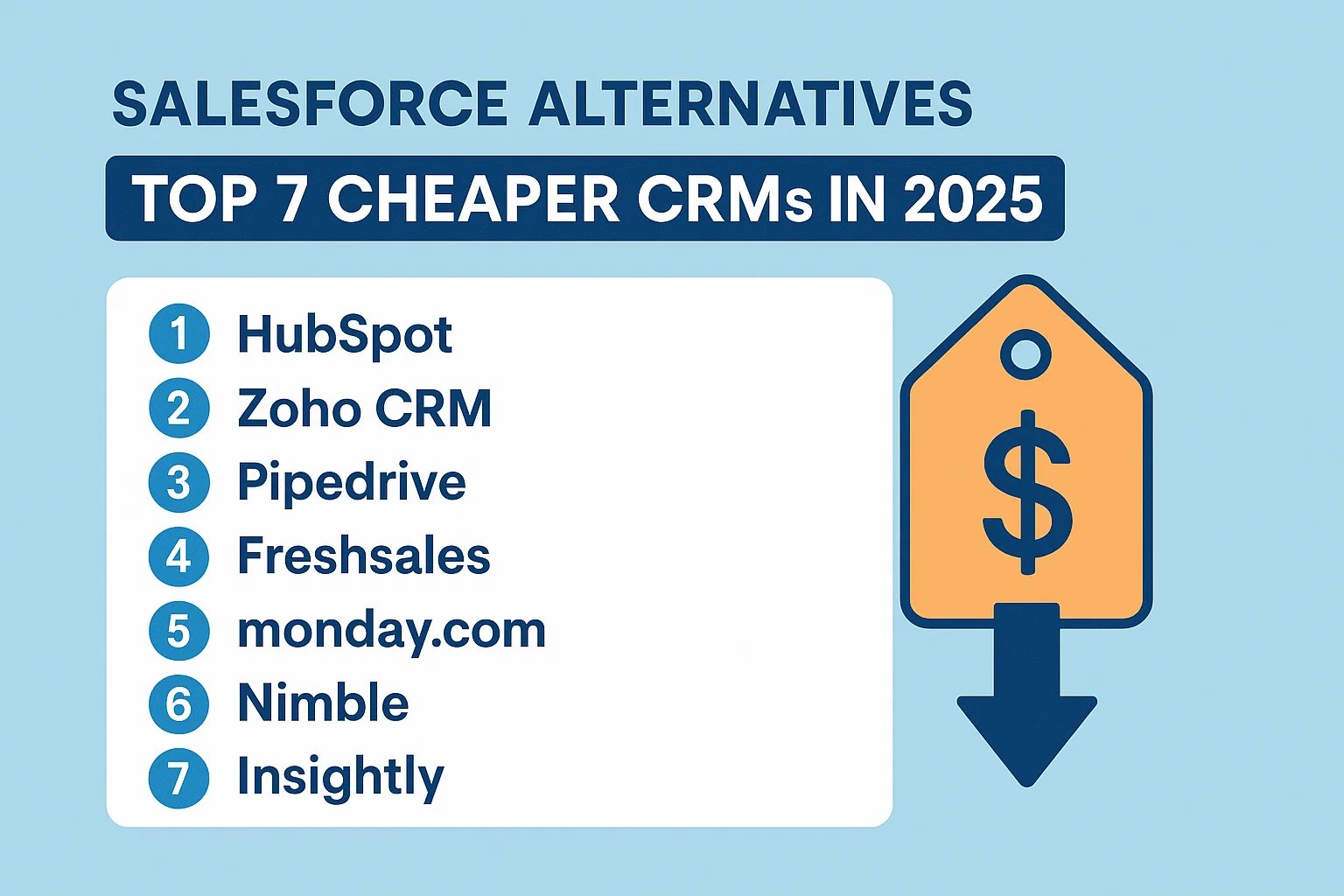
Salesforce remains one of the most powerful and widely used CRM platforms in the world. However, its pricing can be a major barrier for startups, small businesses, and even mid-sized companies. In 2026, several affordable CRM alternatives provide similar automation, AI-driven analytics, integrations, and scalability—at a fraction of the cost.
Why Consider Salesforce Alternatives?
- Cost-Effectiveness: Comparable features at significantly lower monthly pricing
- Ease of Use: Faster onboarding and intuitive interfaces for small teams
- Flexible Pricing: Scalable plans suitable for growing businesses
- Specialized Features: Industry-specific capabilities for SaaS, e-commerce, and services
- Integration-Friendly: Seamless connectivity with marketing, ERP, and analytics tools
Top 7 Salesforce Alternatives in 2026
| CRM | Best For | Key Features | Pricing |
|---|---|---|---|
| HubSpot CRM | Small & medium businesses | Free plan, marketing automation, email tracking, sales pipeline | Free – $120/month |
| Zoho CRM | Growing businesses | Zia AI, automation, omnichannel communication, analytics | $14 – $52/user/month |
| Freshworks CRM | Mid-market teams | AI lead scoring, workflow automation, multi-channel engagement | $35 – $125/user/month |
| Pipedrive | Sales-focused small teams | Pipeline management, deal tracking, email automation, reporting | $14 – $49/user/month |
| Monday.com CRM | Project-driven teams | Custom dashboards, task automation, marketing & sales integrations | $10 – $16/user/month |
| Insightly | SMBs & service businesses | Pipeline tracking, workflow automation, reporting | $29 – $49/user/month |
| Agile CRM | Startups & small businesses | Contact management, marketing automation, telephony, reporting | Free – $49/user/month |
How to Choose the Right Salesforce Alternative
- Evaluate core needs: sales, marketing, support, or all-in-one CRM
- Assess integration requirements with email, ERP, and analytics tools
- Compare pricing versus feature depth
- Ensure scalability for future growth
- Prioritize user-friendly interfaces for faster adoption
Benefits of Switching to an Affordable CRM
- Lower Costs: Reduced subscription expenses without losing essential functionality
- Faster Deployment: Quick setup and onboarding
- Greater Flexibility: Pay only for needed modules and features
- Higher ROI: Faster return on investment for SMBs
- Industry Optimization: Tailored solutions for specific business types
Case Study: Small SaaS Business Migration
A SaaS startup migrated from Salesforce to Zoho CRM in 2026 and achieved:
- 60% reduction in CRM costs
- Improved lead management using Zia AI
- Better customer engagement and visibility
- 25% faster deal closure
Tips for Smooth CRM Migration
- Audit and clean existing CRM data
- Choose a platform with strong import/export tools
- Train teams on new workflows and automation
- Define KPIs to measure migration success
- Gradually enable advanced features
Conclusion
Choosing a cost-effective Salesforce alternative in 2026 can provide similar automation, AI insights, and integrations while dramatically lowering expenses. Platforms like HubSpot, Zoho, Freshworks, Pipedrive, Monday.com, Insightly, and Agile CRM deliver strong performance, scalability, and ROI—making them ideal for small to mid-sized businesses seeking enterprise-level capabilities without enterprise pricing.
Frequently Asked Questions (FAQs)
1. Are these CRMs cheaper than Salesforce?
Yes, all listed alternatives offer comparable functionality at significantly lower cost.
2. Can I migrate Salesforce data easily?
Most modern CRMs support import tools and integrations for seamless migration.
3. Which CRM is best for startups?
HubSpot (free plan) and Agile CRM are excellent affordable choices.
4. Do cheaper CRMs include AI features?
Yes, Zoho and Freshworks provide AI lead scoring, automation, and predictive analytics.
5. How should I choose the right CRM?
Evaluate budget, scalability, integrations, usability, and business requirements.